

I was contacted by William Keo and Yegan Mazandarani, Art Directors at Revue21, with editor Guillaume Gendron joining the process afterwards, to create an illustration about emerging research on the therapeutic use of psychoactive substances.
The article explored how treatments using substances such as psilocybin mushrooms and LSD are being studied as potential therapies for patients suffering from severe addictions and depression that have not responded to conventional psychiatric methods. Rather than framing these substances through their countercultural past, the research highlights methodical clinical protocols, controlled environments, and the guidance of trained therapists throughout the experience, with very promising results.
For the illustration, I chose to move away from the stereotypical psychedelic imagery of the 1970s and instead approach the subject through a more structured surrealism that reflects the scientific rigor behind these studies.
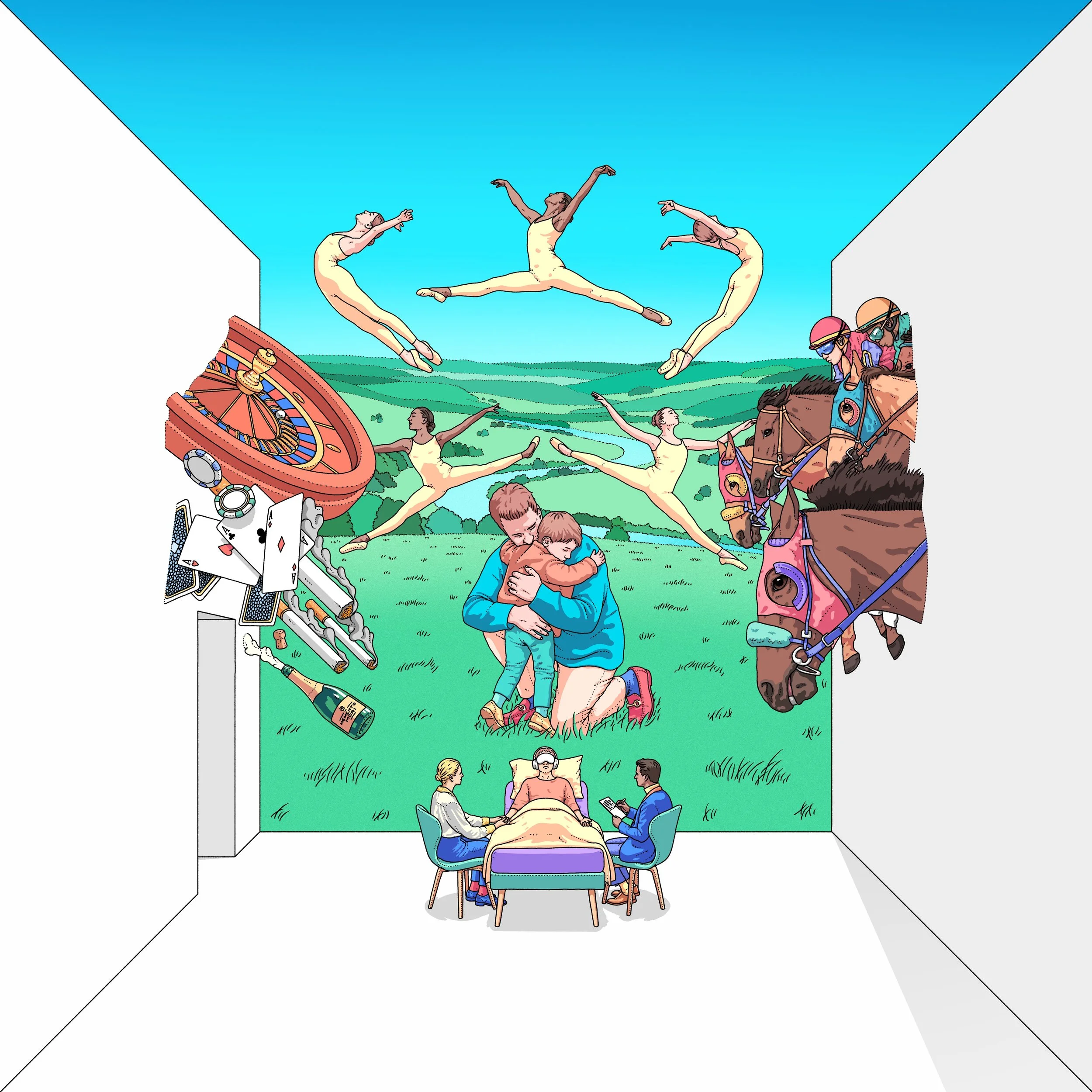
The scene portrays a patient confronting visions of his addictions that press in around him. As the therapeutic process unfolds, the front wall opens into a vast landscape filled with nature and light. This transformation emerges through an emotional reconnection with a long-felt absence of love rooted in childhood, turning a space of confinement into one of tenderness, possibility, and celebration. The symbolic narrative seeks to highlight the powerful act of reinterpreting one’s past, to discover new paths toward healing and new ways of living.
Client: Revue21
Editor: Guillaume Gendron
Art Directors: William Keo and Yegan Mazandarani
Article: Médecine psychédélique: le trip des docteurs cobayes
Journalist: Stéphanie Chayet
Final illustration
application
linework
selected sketch
This piece represents the therapeutic journey from the recognition of addiction and trauma to reconciliation with the past and transformative healing.
A patient undergoes psilocybin-assisted therapy, supported by two therapists, one gently holding the patient’s hand as a grounding gesture commonly used in this modality, and the other documenting the experience. The room symbolizes psychological confinement; its walls project cigarettes, alcohol, gambling, and horse racing, embodying compulsive behaviors and self-destructive cycles.
As the patient confronts these shadows with compassionate guidance, the space begins to transform. A wall dissolves into a vast natural landscape of rivers and greenery, symbolizing emotional release and renewal. Within this expanded space appears the core wound: a child embraced by a father, representing the unmet need for love and recognition that underlies addiction.
From this moment of reconciliation emerges liberation with the dancers rising in celebration, marking the therapeutic breakthrough and the beginning of a renewed life.
This piece represents the ascent of scientific understanding, the progression through which rigorous research expands human knowledge of the mind, consciousness, and mental health.
The work emphasizes the seriousness and methodological integrity of psychedelic research. Doctors ascend the staircase, carrying briefcases, research papers, tablets, and clinical data (metaphors for evidence-based inquiry) while engaged in discussion, reflecting intellectual rigor and collaborative investigation. They step beyond established paradigms, entering a frontier of medical science that challenges existing limits of understanding. It represents the construction of a new discipline and the expansion of mental health treatment through this psychoactive threshold.
This piece represents the carefully constructed therapeutic space created by doctors. It is a nurturing and protective environment that supports deep inner work during the psychedelic journey.
The patient rests on a bed, yet the room has transformed into a field of flowers as part of the patient’s psychedelic inner vision. The bedspread merges with the landscape, symbolizing integration: the dissolution of boundaries between inner and outer worlds, ego and nature, and a reconnection with the whole.
At the center stands the “tree of life”, representing vitality, growth, and renewal. The former burdens of addiction and confinement no longer weigh heavily on the patient’s mind and body, instead, they float in the sky as tethered hot-air balloons. From the natural environment emerges a hand (the healing force of therapy and life) reaching to cut their strings. This gesture embodies release, autonomy, and healing: the letting go of harmful habits and patterns of avoidance that perpetuate suffering.
🌳 3 trees were planted for this project via Tree-Nation